
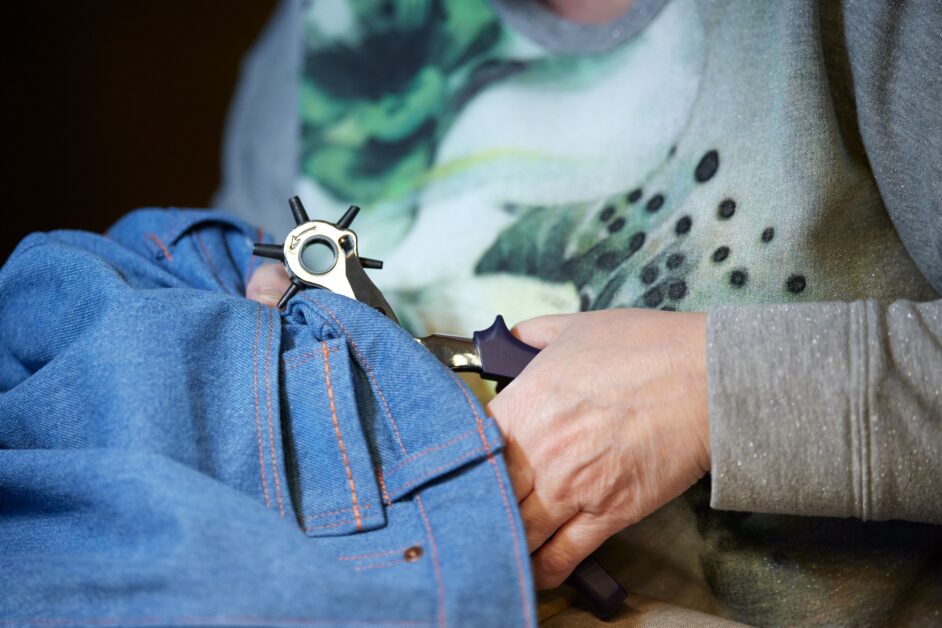
That drawer full of old jeans that no longer fit right doesn’t have to end up in a donation bag. Turning jeans into a skirt takes an afternoon, basic sewing supplies, and one pair of jeans that already fits well at the waist. The waistband, pockets, and belt loops stay exactly where they are, so the hardest part of fitting a garment is already solved before the first cut.
This project works well as a first refashioning attempt because the jeans themselves do most of the shaping. We’ll walk through choosing the right pair, cutting and laying the fabric flat, and stitching the skirt together by machine or by hand, with fixes along the way for the fit and sewing snags beginners run into most.
Which Jeans and Supplies Do You Need?
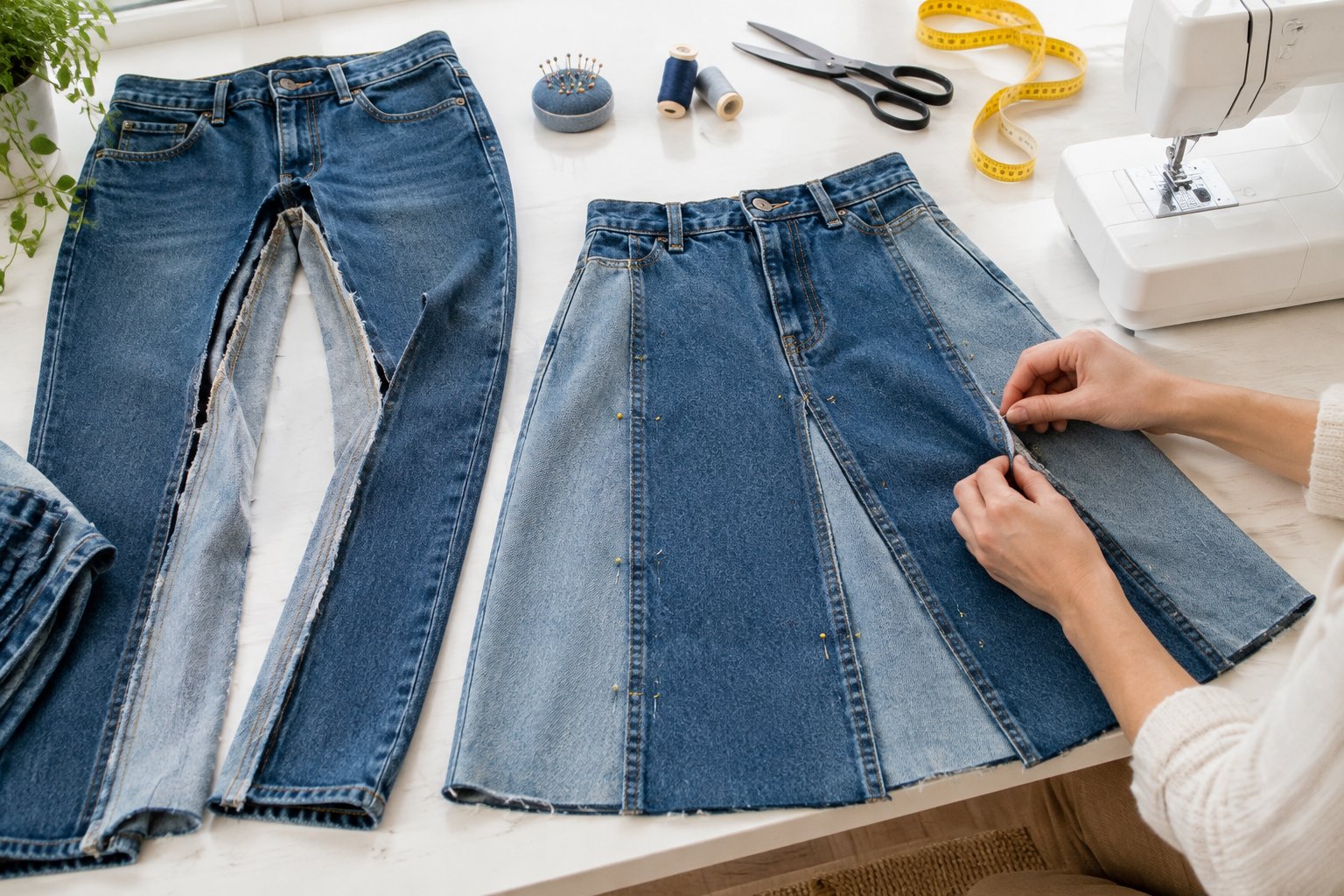
The right starting jeans and a complete supply list determine whether the rest of this project goes smoothly. Pick jeans for fit first, then gather cutting tools, marking tools, and either machine-sewing or hand-sewing supplies before touching the scissors.
Choose Jeans That Fit at the Waist and Hips
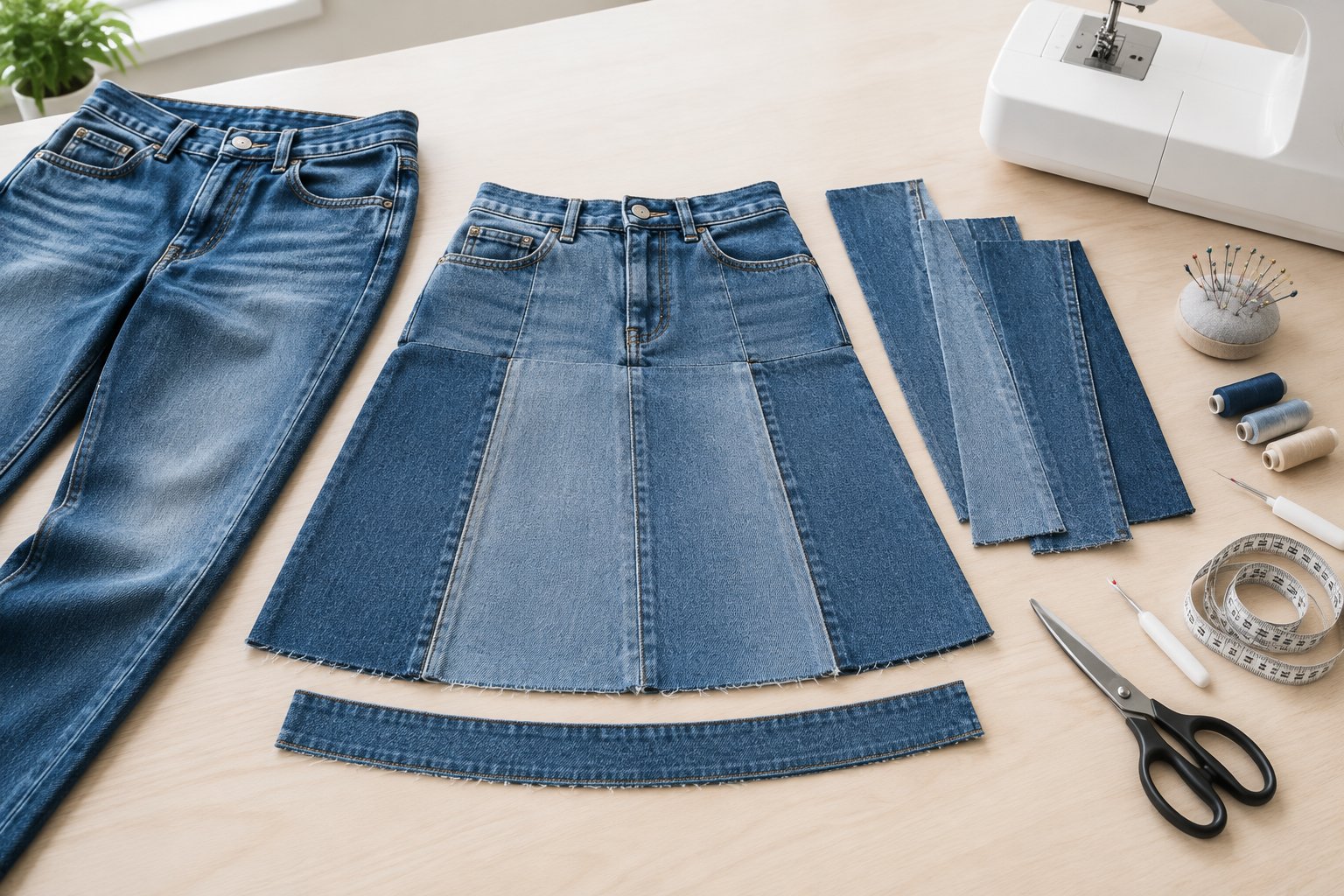
Pick a pair of jeans that already fits comfortably at your waist and hips, since the waistband won’t be altered. Cotton denim with a little structure holds a seam better than very stretchy blends. Repurposed jeans with a worn-out hem, a low rise that bothers you, or knees that are blown out are good candidates, since the skirt cuts away the problem areas anyway.
Tick-Off Supplies Checklist: Shared Essentials and Optional Helpers
These items apply no matter which stitching method is chosen:
- Jeans that fit at the waist and hips
- A seam ripper (a small hooked tool that picks out stitches one at a time without tearing the fabric)
- Fabric scissors
- Tailor’s chalk or a fabric marking pen
- A tape measure
- Sewing pins or sewing clips (clips grip thick denim layers without leaving holes)
Optional helpers include a rotary cutter with a self-healing mat for straighter cutting lines, and an iron to flatten seams before stitching.
Machine-Sewing and Hand-Sewing Supplies
A sewing machine fitted with a denim needle handles multiple layers of cotton denim far more reliably than a standard needle, which tends to skip stitches or snap. Readers without a machine, or anyone comparing models before starting, can check our guide to the best sewing machine for jeans to buy for machines built to handle thick seams. The hand-sewing alternative only needs a sturdy needle meant for heavy fabric and strong thread, ideally topstitching or upholstery thread rather than regular all-purpose thread.
How Do You Cut and Shape the Jeans?
Cutting the jeans apart and laying the pieces flat is what actually turns a pair of pants into a mini skirt or knee-length skirt shape. Opening the inseams, flattening the crotch seams, and patching gaps with fabric from the cut-off legs are the three moves that do the work, so it helps to understand each one before picking up scissors.
Mark and Check the Length Before Cutting
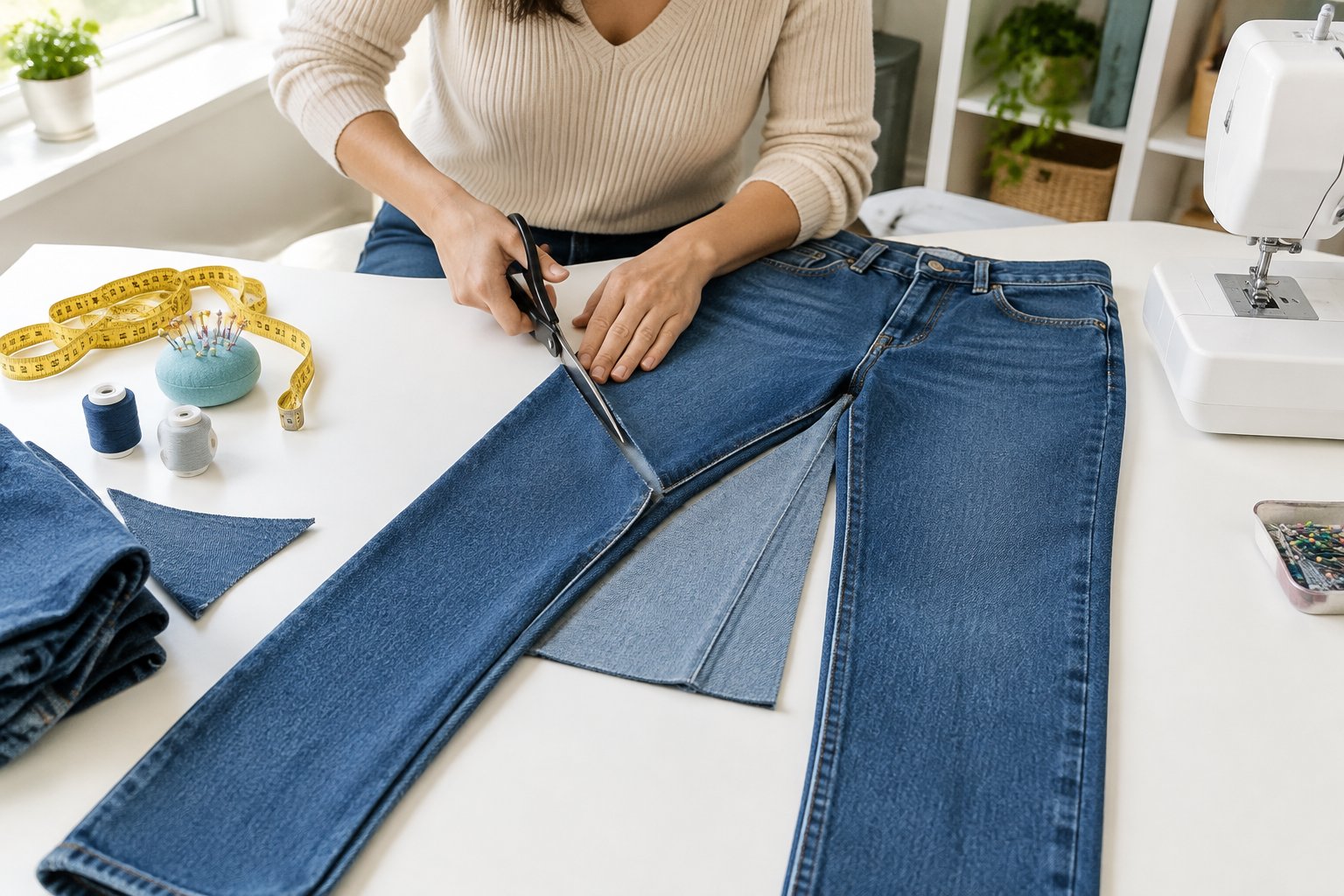
- Put the jeans on and decide where you want the skirt hem to land.
- Mark that spot on both legs with tailor’s chalk, checking that the marks sit level on both sides.
- Measure from the waistband down to each mark to confirm they match.
- Add about 1 inch below your marked line before cutting, to allow for a hem or seam allowance (the extra fabric width left outside a stitching line, which gets folded under or trimmed later).
- Cut straight across both legs at the adjusted line, setting the cut-off legs aside. Do not discard them.
Open the Inseams and Flatten the Crotch Seams
- Turn the jeans inside out so you’re working on the wrong side (the inside of the fabric, which usually faces the body and is less finished-looking than the right side, the outer, finished-looking surface).
- Use the seam ripper to open the inner leg seams, starting at the cut hem and working up to the crotch seam.
- Open the center front seam down to the base of the fly, and the center back seam down to the yoke.
- Lay the jeans flat on a table, front side up. Lap one front leg panel over the other so the fly area lies flat without a lump, and pin it in place.
- Repeat for the back panel, overlapping the fabric so it lies flat rather than forcing the inner leg edges to meet.
Fill the Gaps with Cut-Off Leg Fabric and Try On the Skirt
- Check the front and back for any gap left between the overlapped panels, usually near the hemline.
- Cut a piece from one of the reserved leg sections to match each gap, cutting it slightly larger than needed.
- Slide the patch piece underneath the gap so it overlaps the raw edges by at least 5/8 inch, then pin it in place.
- Try on the partially pinned skirt to check the fit through the hips and the flare of the upcycled denim shape.
- Adjust pins at the center seams if the skirt feels too snug or too loose before any permanent stitching happens. This is the last easy checkpoint before cutting becomes hard to undo, so take the time to turn in front of a mirror.
How Do You Stitch and Hem the Skirt?
Permanent stitching locks in the shape once the pinned fit checks out, and a sewing machine with a denim needle handles this fastest. A labeled hand-sewing alternative follows for anyone working without a machine, and the hem can finish folded under or left raw depending on the look wanted.
Machine-Sew the Pinned Seams and Panels
- With the skirt still pinned from the cutting stage, stitch the center front and center back seams first, sewing 5/8 inch from the raw edge.
- Backstitch at the start and end of each seam to lock the stitching.
- Stitch a second line about 1/4 inch from the first for reinforcement, since denim seams take more strain than lighter fabrics.
- Stitch the patch panels in place along each raw edge, again sewing 5/8 inch from the edge and reinforcing with a second line.
- Trim excess fabric from the inside seams, leaving about 5/8 inch beyond the stitching so the seam allowance doesn’t bunch under the skirt.
Hand-Sewing Alternative: Secure and Reinforce the Seams
A sturdy backstitch (a hand stitch where each new stitch loops back into the end of the last one, so the stitching line looks solid rather than dashed) holds denim far better than a simple running stitch. Work with short stitches, about 1/4 inch apart, and pull the thread snug after every few stitches rather than one long pull at the end.
The thickest point, where the crotch seam and the patch panel overlap several layers of denim, is the hardest spot to push a needle through by hand. Go slowly there, and consider doubling the thread or stitching that junction twice for reinforcement, since it’s the spot most likely to come loose with wear.
Choose a Folded Hem or a Controlled Frayed Hem
A folded hem turns under the raw edge and stitches it flat for a clean finished look, while a frayed hem is left raw and allowed to fringe with washing and wear for a casual upcycled denim look. For a folded hem, press the raw edge under about 1 inch and machine-stitch close to the fold. For a frayed hem, stitch a single line about 1 inch from the raw edge first; this keeps the fraying from creeping upward past that line over time.
How Can You Fix Common Fit and Sewing Problems?
Most fit and stitching problems in a jeans-to-skirt project trace back to one of four spots: the hip overlap, the panel gaps, the denim thickness, or the hem line. Catching the issue early, before permanent stitching, is almost always easier than fixing it after.
Waist Fits but Hips Pull, or the Crotch Seam Bunches
Pulling at the hips usually means the front or back panels are overlapped too tightly rather than left to lie naturally. Before cutting, unpin and re-lap the panels with a little more ease, checking the fit again before stitching. If the crotch seam area bunches into a lump, flatten it by trimming a small wedge of excess fabric from underneath rather than forcing it flat with more pins.
Panels Gap or Sit Unevenly, or Seams Pucker
A visible gap between the cut-off leg patch and the main fabric means the patch was cut too small or positioned without enough overlap. Unpick the seam, cut a larger patch from the spare leg fabric, and re-pin with at least 5/8 inch of overlap before restitching. Puckered seams after stitching usually come from pulling the fabric while feeding it through the machine; let the denim move under the needle on its own and use a longer stitch length for thick layers.
Thick Denim Breaks Thread or Hand Stitches Loosen
Skipped stitches or snapped thread at a seam intersection almost always point to a needle not suited for denim. Swap in a fresh denim needle, and if the machine still struggles, hand-walk the needle through the thickest spot using the handwheel instead of the foot pedal. For anyone shopping for a machine that handles this better long-term, our guide to the best sewing machine for jeans to buy outlines models built for multiple layers of heavy fabric. Hand stitches that loosen with wear usually need a second reinforcing pass of backstitching at that exact spot, plus a double-threaded needle for extra hold.
The Hem Looks Uneven When Worn
An uneven hem once the skirt is on the body often means the length was measured while standing still but the panels shifted slightly during stitching. Try the skirt on, mark the new uneven spots with chalk while standing naturally, then trim and re-hem only those sections. For a longer-term reference on getting clean seam edges across any future sewing project, our guide to seam finishes covers options beyond the folded and frayed hems used here.
A Wearable Skirt from Jeans You Already Own
A finished upcycled denim skirt keeps the waistband, pockets, and belt loops of the original jeans while trading the legs for a flared, wearable shape. The project asks for basic tools (a seam ripper, pins, scissors, and either a machine or a sturdy hand needle) and rewards patience at the pinning and try-on stage more than speed at the sewing machine.
Readers who enjoy this kind of garment reshaping might also find our guide to how to make a circle skirt a beginner sewing project a natural next step, since it builds on the same cutting-and-hemming skills with fresh fabric instead of repurposed denim.
Frequently Asked Questions
Can you make a skirt from jeans without sewing?
A temporary no-sew version is possible using fabric glue or fusible hem tape along the seams and patch panels instead of stitching. This holds for light wear but won’t stand up to repeated washing or stretching at the hip seams the way machine or hand stitching does.
How do you make a knee-length skirt from jeans?
Mark and cut the legs at knee length instead of a shorter mini skirt length, then follow the same steps for opening the inseams, flattening the crotch seams, and patching gaps with the cut-off leg fabric. The longer length usually needs a bigger patch panel on each side, since the gap between the overlapped front and back panels widens as the hemline drops.
Can you turn jeans into a long skirt?
A long skirt usually needs a second pair of jeans for extra fabric, since one pair’s legs rarely cover a floor-length or maxi hem. The second pair’s legs can be cut into wider panels or wedges and stitched into the side seams to add length and flare beyond what the original jeans supply.
Can you add other fabric to a skirt made from jeans?
Purchased contrast fabric can replace or supplement the cut-off leg patches in the front and back panels. Cotton or denim-weight fabric blends in most seamlessly, since it handles pressing and stitching the same way the surrounding jeans fabric does.
Do stretch jeans work for this project?
Stretch jeans can be cut and stitched using the same steps, though the added elastane makes the fabric shift more while pinning and sewing. Pin generously and sew slowly through stretch denim to prevent the layers from sliding out of alignment under the needle.
