

A standard Pokémon card measures 2.5 × 3.5 inches, or 63 × 88 mm. That’s the same footprint as a poker card, a Magic: The Gathering card, and most sports cards, so if you’ve ever bought a sleeve for a baseball card, you already own the right size for your Pokémon collection.
Jumbo cards are a different story. Pokémon has released oversized promos at several different measurements over the years, so there isn’t one fixed jumbo size to memorize, and grabbing the wrong sleeve or toploader for one can leave it loose or crushed.
I’ve spent enough time sorting binders and boxing up trade stock to know that a few millimeters can be the difference between a card sliding in cleanly and one that bends at the corner. Here’s a quick snapshot before I get into the details:
|
Verified Dimensions / Variability |
Sleeve-Fit Check |
Binder or Box Consideration |
|
|---|---|---|---|
|
Standard card |
2.5 × 3.5 in (63 × 88 mm), consistent across sets |
Fits any standard-size sleeve |
Fits standard 9-pocket pages and toploaders |
|
Jumbo card |
Varies by release, no single fixed size |
Needs oversized sleeves, sized to that specific card |
Requires oversized binder pages or display holders |
Getting the measurement right matters whether you’re prepping a set for a binder, sleeving a fresh pull, or figuring out if that promo card from a collection box will fit anywhere at all.
Standard Dimensions in Inches, Millimeters, and Centimeters
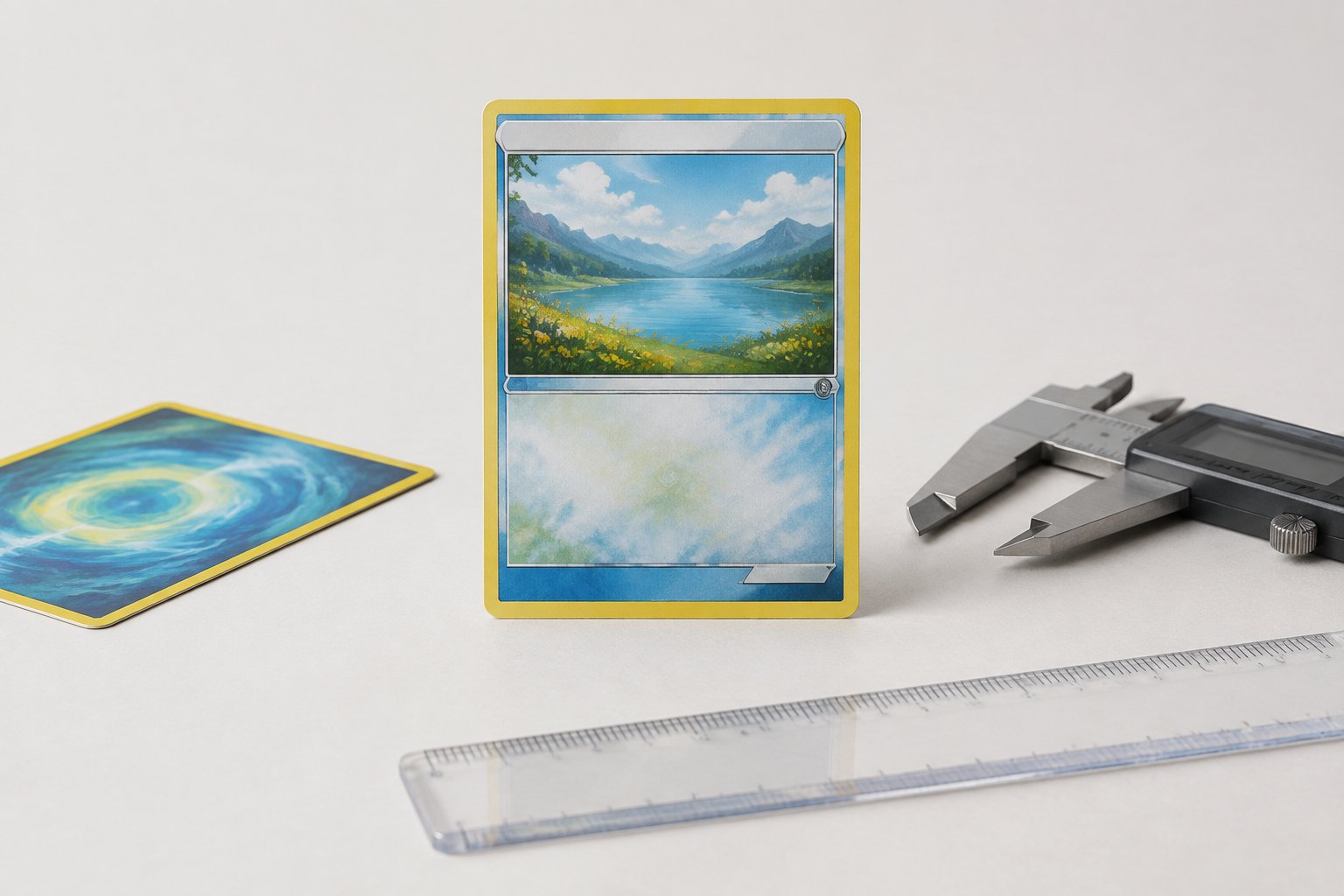
Every standard Pokémon card measures 2.5 × 3.5 inches, which converts to 63 × 88 mm or 6.3 × 8.8 cm. That size has stayed the same since the game launched, so a 1999 Base Set card and a 2026 Scarlet & Violet card share the same footprint down to fractions of a millimeter.
A Quick Size Chart for Standard and Jumbo Cards
|
Card Type |
Inches |
Millimeters |
Centimeters |
|---|---|---|---|
|
Standard |
2.5 × 3.5 |
63 × 88 |
6.3 × 8.8 |
|
Jumbo (varies by release) |
roughly 5 × 7 up to 5.8 × 8.3 |
roughly 127 × 178 up to 148 × 210 |
roughly 12.7 × 17.8 up to 14.8 × 21 |
I’d treat the jumbo row as a range rather than a fixed number. Different eras of oversized promos used different print specs, which I get into further down.
Exact Conversions vs. Rounded Metric Labels
The 2.5 × 3.5 inch figure is the round number everyone uses, but the precise conversion lands closer to 63.5 × 88.9 mm. Card sleeve packaging and product listings often round to 63 × 88 mm for simplicity, and that rounding rarely causes a fit problem since sleeves are cut with a few millimeters of built-in slack.
I’ve measured enough cards with a caliper to notice manufacturing tolerances of about half a millimeter in either direction, depending on the print run. That’s normal and won’t affect how a card sits in a sleeve or binder pocket.
Are English and Japanese Cards the Same Size?
English and Japanese Pokémon cards share the same physical dimensions. The “Japanese size” label printed on some sleeve packaging actually refers to the smaller Yu-Gi-Oh! card format (59 × 86 mm), not to Japanese-language Pokémon cards, which is a mix-up I see trip up new collectors constantly.
If you’re sorting a mixed collection that includes Yu-Gi-Oh! cards, keep in mind those genuinely are smaller and need their own sleeve size. Every language version of a Pokémon card, full art or otherwise, uses the same standard dimensions.
How Thickness Affects Storage
A standard Pokémon card runs about 0.30 to 0.34 mm thick, which is thin enough that thickness rarely factors into sleeve selection but matters a lot once you’re stacking cards in a box. Fifty sleeved cards add up fast, and textured or holo-heavy cards can run marginally thicker than a plain common.
When I’m loading a storage box, I count on roughly a third of a millimeter per card as a baseline and add extra room for double-sleeved cards or anything in a toploader.
Why Do Jumbo Card Dimensions Vary?
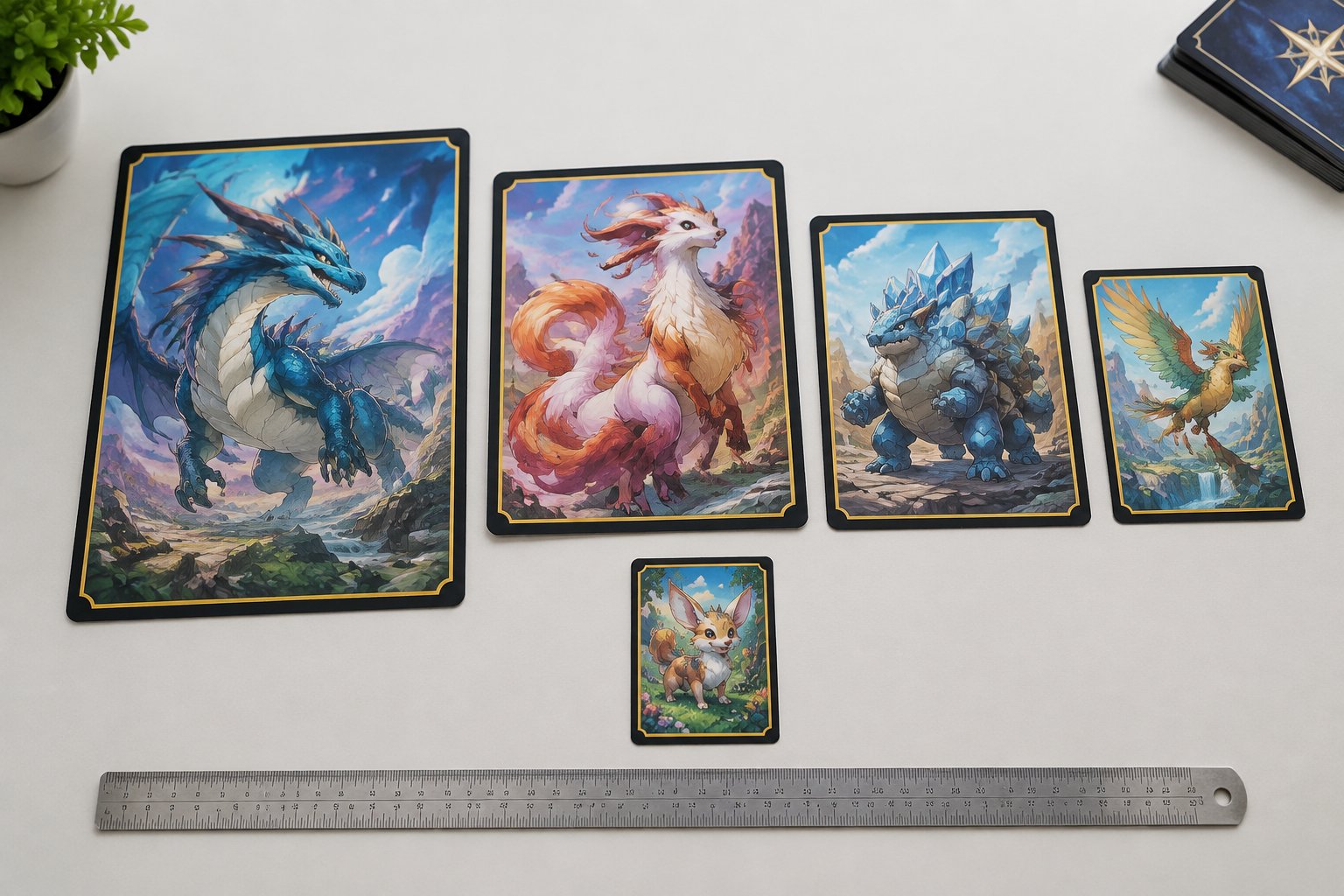
Jumbo Pokémon cards don’t share one universal size because The Pokémon Company has used different print specs for different promotional runs over the years. Some oversized cards from earlier eras measured closer to 5 × 7 inches, while more recent releases have landed nearer to 5.8 × 8.3 inches, so assuming a single jumbo measurement is a common mistake.
Oversized Promos, Box Toppers, and Other Variants
Jumbo cards show up as box toppers in collection boxes, as CoroCoro magazine inserts in Japan, and as standalone oversized promos handed out at events. Each of these categories can carry its own dimensions, and even within “jumbo,” a box topper from one product line isn’t guaranteed to match the size of a jumbo promo from another.
This variability is exactly why I never recommend buying oversized sleeves or a display frame based on a generic “jumbo size” listing. The safest approach is always to measure the specific card in your hands.
How to Measure an Individual Jumbo Card
Grab a ruler or a caliper and measure the card’s width and height edge to edge, not corner to corner. Record both measurements in millimeters for precision, then compare that figure against the interior dimensions listed for oversized sleeves or toploaders before buying.
If you’re storing several jumbo cards from different releases, measure each one individually rather than assuming they match. I’ve seen two “jumbo” cards from different years sit a full centimeter apart in height.
How Can You Tell Whether a Sleeve Fits?
A sleeve fits when its stated interior dimensions leave a small margin of extra space around your card’s actual measurements, not when the exterior package size looks close enough. Getting this right takes comparing three things: the numbers, the opening, and how the card behaves once it’s actually inside.
Compare Card Measurements with Usable Sleeve Space
Start with your card’s exact width and height, then check the sleeve’s usable interior dimensions rather than its outer size. A standard sleeve built for a 63 × 88 mm card typically measures closer to 66 to 67 mm wide and 91 to 92 mm tall on the inside, which gives roughly 3 to 4 mm of slack on each dimension.
That slack matters. It’s what lets the card slide in without catching on a corner, which is the single most common cause of accidental bends and dings during sleeving.
Check the Opening and Ease of Insertion
Look at which edge the sleeve opens from before you buy in bulk. Most standard penny sleeves and deck sleeves open from the top, while some inner sleeves are made to load from the side, which pairs better with binder pages since the open edge tucks against the pocket rather than facing outward.
Slide a spare card in and out a few times. If you feel resistance at the corners or need to flex the card to get it started, that sleeve runs tighter than it should for regular handling.
Fit Inner and Outer Sleeves Without Pressure
Double-sleeving means placing the card in a snug inner sleeve first, then sliding that whole unit into a slightly larger outer sleeve. The standard order is inner sleeve against the card, outer sleeve as the second layer, often placed opening-side down so the two open ends face opposite directions and seal each other off from dust.
After double-sleeving, check for a few warning signs. The card shouldn’t bow or bend inside the combined sleeves, it shouldn’t slip loosely if you tip the pair upside down, and you shouldn’t see a trapped air bubble pressing the sleeve outward at the card’s edges. Any of those signs means the combination is either too tight or too loose, and forcing a fit is how corners get soft-bent.
Will the Sleeved Card Fit Your Binder or Box?
A sleeve fitting your card doesn’t guarantee the sleeved card fits your binder or storage box, since binder pockets and box interiors are built around their own separate tolerances. I check this as its own step every time I move cards between storage formats.
Check Binder-Pocket Space and Page Turning
Look at the pocket’s usable interior space, not just the page’s outer dimensions. A 9-pocket binder page needs enough room for your sleeved card to sit flat without the pocket seam pressing against the card’s edge, and you should be able to turn the page without feeling resistance or seeing the card bow inside the pocket.
Side-loading pockets tend to hold sleeved cards more securely during page turns than top-loading ones, since there’s no open edge for a card to slip out of while flipping through the binder.
Allow for Sleeves, Dividers, and Lid Clearance in Boxes
A storage box needs to account for the sleeved card’s full width, height, and thickness, plus any dividers you’re using to separate sections. Stack too many sleeved cards tightly against a box’s lid and you risk compressing the ones at the top every time it closes.
Leave a little breathing room rather than packing a box to capacity. A toploader adds noticeable thickness on top of a sleeve, so if you’re mixing sleeved singles with toploader-protected cards in the same box, measure the tallest combination and size the box around that, not around the thinnest cards.
Print-Friendly Fit and Storage Checklist
Copy this list onto paper or a notes app before you buy sleeves, binders, or boxes:
- Card width: _______ mm Card height: _______ mm
- Sleeve interior width: _______ mm Sleeve interior height: _______ mm
- Sleeve opening direction: top ☐ side ☐
- Insertion test: slides freely ☐ catches at corner ☐
- Double-sleeve check: no bowing ☐ no slipping ☐ no trapped air ☐
- Binder pocket interior width: _______ mm height: _______ mm
- Page turns without pressure on card: yes ☐ no ☐
- Box interior height available: _______ mm
- Lid closes without compressing top cards: yes ☐ no ☐
Measure the Card, Then Check Every Layer of Storage
Standard Pokémon cards hold a reliable 2.5 × 3.5 inch (63 × 88 mm) size across every language and era, which makes sleeve shopping simple once you know that number. Jumbo cards break that consistency, so measuring each oversized card individually before buying sleeves or a display holder saves you from a mismatched fit.
Sleeve fit comes down to comparing your card’s exact measurements against a sleeve’s usable interior space, then testing the opening direction and insertion feel with a spare card first. From there, binder pockets and storage boxes each need their own check, since a sleeve that fits the card perfectly doesn’t automatically mean the sleeved card fits the page or the box you already own.
Measuring once at each layer, card, sleeve, binder pocket, and box, is the habit that keeps a collection organized without bent corners or crushed cases.
Frequently Asked Questions
Are all Pokémon cards the same size?
Yes, every standard Pokémon card measures 2.5 × 3.5 inches (63 × 88 mm), regardless of rarity, language, or print era. Full art, gold, and textured cards share this exact footprint; only jumbo promos and box toppers deviate from it.
Are all jumbo Pokémon cards the same size?
No, jumbo card dimensions vary by release, with some oversized promos closer to 5 × 7 inches and others nearer 5.8 × 8.3 inches. Measure each jumbo card individually rather than assuming a single universal jumbo size before buying sleeves or a display holder.
How do I check whether a sleeve will fit my card?
Measure your card’s width and height, then compare those numbers against the sleeve’s stated usable interior dimensions rather than its outer package size. Test the fit with a spare card, sliding it in and out to confirm it moves freely without catching at the corners.
Do Japanese Pokémon cards need smaller sleeves?
No, Japanese-language Pokémon cards use the same standard 63 × 88 mm dimensions as English cards. The “Japanese size” sleeves sold in stores refer to the smaller Yu-Gi-Oh! card format, not to Japanese Pokémon cards.
Will a sleeved Pokémon card fit a 9-pocket binder?
In most cases, yes, since standard 9-pocket binder pages are built around the same 63 × 88 mm card size plus a sleeve’s added slack. Check the pocket’s usable interior space and confirm the page turns without pressing on the card before loading a full binder.
